


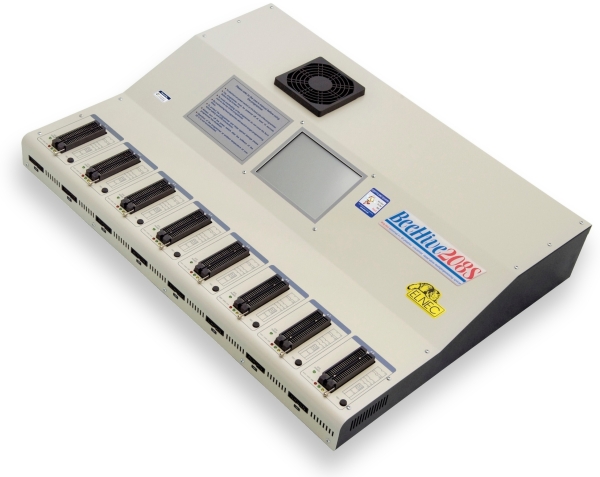
BeeHive208S (ord.no. 60-0054)
Extremely fast universal 8x 48-pin-drive stand-alone concurrent production programmer ( multiprogramming system ).
Discontinued product. Replacement: no direct replacement.
Short description:
- 141309 supported devices from 485 by manufacturers version of SW (4.14)
- eight independent universal programming modules (BeeProg2 based) in one unit
- extremely fast programming, one of the fastest programmers in this category.
Sustainable programming speed greater than 5 MBytes per second.
Programs 2 GB eMMC NAND Flash within less than 365 sec. - powerful independent pin-driver circuit for each and every pin of the programmer
- in-circuit programming capability through ISP connector
- graphics control unit with touch screen
- very low voltage support for the latest Flash memory chips
- ESD protection on each pin of the sockets
- no adapter required for any DIL devices
- Microsoft Windows 10 IoT Enterprise driven control PC inside of the programmer
- unique quick reaction to customer's needs - software update can be ready within a day from request, by OnDemand software
- developed and made in Slovakia
- warranty - 3 years
- approved by CE laboratory to meet CE requirements

Optional accessories:
- Programming Adapters (Socket Converters)
- Accessories: Calibration test pod, Vacuum pen, LPT port cable, …
Features
GENERAL
- BeeHive208S programmer is practically identical with the BeeHive8S programmer, difference is "only" much higher programming speed (up to 10x) of high-capacity memories.
- The BeeHive208S is an extremely fast universal 8x 48-pin-drive Stand-Alone concurrent multiprogramming system designed for high volume production programming with minimal operator effort. The chips are programmed at near theoretical maximum programming speed.
- The BeeHive208S consists of 8 independent isolated universal programming modules, based on the BeeProg2 programmer hardware. Therefore the sockets can run asynchronously (concurrent programming mode). Each programming module starts programming at the moment the chip is detected as inserted in the socket properly - independent of the status of the other programming modules. As a result, seven programming modules can be working while replacing the programmed chip on the eighth.
- Graphics control unit with touch screen provides basic control and easy monitoring of the programming flow.
- Modular construction of the hardware - the programming modules work independently - allowing for continued operation if a part of the circuit becomes inoperable. It also makes service quick and easy.
- Hands-free operation: asynchronous and concurrent operation allows a chip to begin programming immediately upon insertion. The operator merely removes the finished chip and inserts a new chip. Operator training is therefore minimized.
- Supports all types of the silicon technologies found in the programmable devices of today and tomorrow without family-specific modules. You can be sure that new device support will require only a software update and (if necessary) a simple package convertor (programming adapter), therefore minimizing ownership costs.
- Using built-in in-circuit serial programming (ISP) connector, the programmer is able to program ISP capable chips in circuit.
- Combines very competitive pricing with excellent hardware design for reliable programming. Probably the best "value for the money" programmer in its class.
- Very fast programming due to high-speed FPGA driven hardware and execution of time-critical routines inside the programmer. As a result, when used in manually-operated production, this one-socket-programmer in most cases waits for an operator.
- Banana jack for ESD wrist strap connection to easily implement ESD protection control.
HARDWARE
- FPGA based totally reconfigurable 48 powerful TTL pin-drivers provide H/L/pull_up/pull_down and read capability for each pin of socket. Advanced pin-drivers incorporate high-quality high-speed circuitry to deliver signals without overshoot or ground bounce for all supported devices. Pin-drivers operate down to 1.8V so you'll be ready to program the full range of today's advanced low-voltage devices.
- The programmer performs device insertion test on each programming module based on the check of proper signal path between the programmer and programmed device before it programs each device. In dependence on programming configuration it identifies missed or poor contact between programmed device and the ZIF socket of the programming adapter (or the programmer directly), missed or poor contact between the programming adapter and the programmer and it's also able to indicate wrong position of device in the ZIF socket of the programmer / the programming adapter (moved, rotated, backward oriented). These capabilities, supplemented by over-current protection and signature-byte check, help prevent chip damage due to operator error.
- The self-test capability allows the operator to run the diagnostic part of software to thoroughly check the health of the each programming module.
- Built-in protection circuits eliminate damage to the programming module and/or programmed device due to environment or operator failure. All ZIF socket pins inputs and all pins of ISP connector of the BeeHive208S programmer are protected against ESD up to 15kV.
- When programming specification require, the (BeeHive208S) programmer performs programming verification at the marginal level of supply voltage, which, obviously, improves programming yield, and guarantees long data retention.
- Various socket converters are available to handle devices in PLCC, SOIC, PSOP, SSOP, TSOP, TSSOP, TQFP, QFN (MLF), SDIP, BGA and other packages.
SOFTWARE (production mode control)
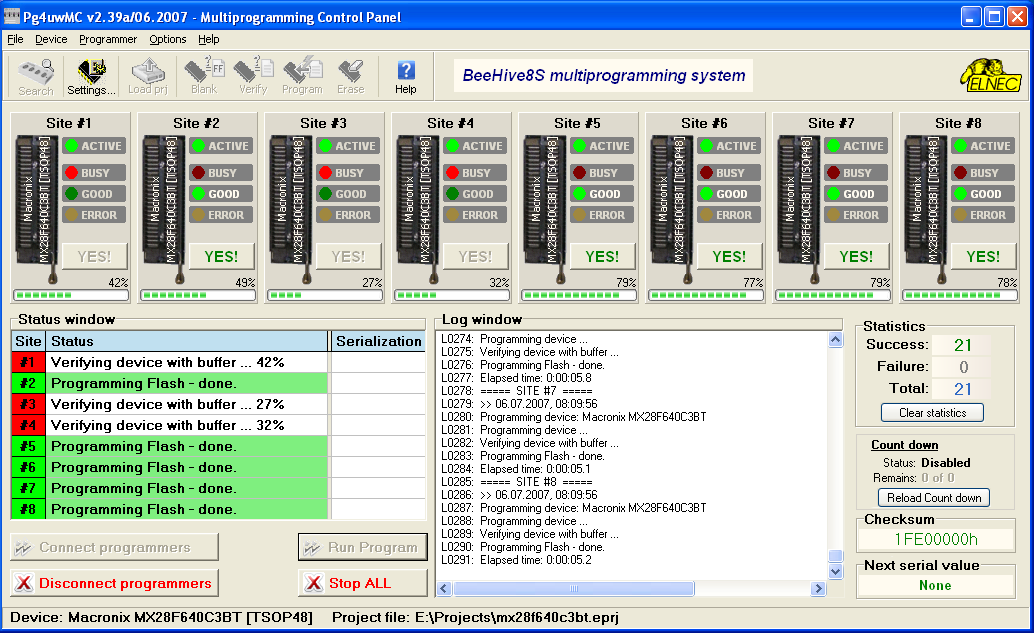
- This part of the software is designed for the easy monitoring of high-volume production operations.
- There are two ways to control and monitor programming flow of the BeeHive208S Stand-Alone multiprogramming system: 1) using the control unit or 2) using a standard display/keyboard/mouse.
- The Graphics control unit with touch screen provides all basic information about programming flow and allows the most basic level of controlling of the BeeHive208S programmer.
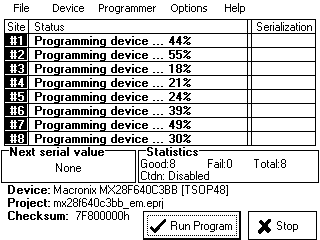
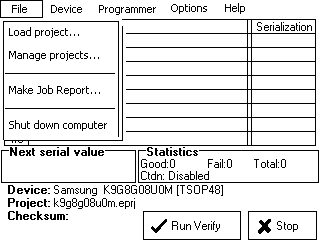
- Usage of a display/keyboard/mouse allows viewing all necessary information about programming flow while providing more comfort to the operator.
- Operator-friendly control software combines many powerful functions with ease of use. Graphic user interface provides an overview of all important activity results without burdening the operator with non-important details.
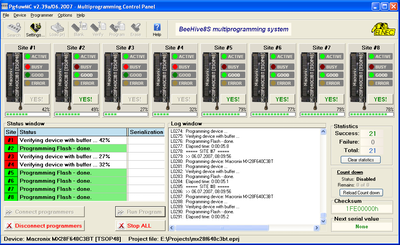
- A Project file is used to control the BeeHive208S Stand-Alone multiprogramming system. A Project file contains user data, chip programming setup information, chip configuration data, auto programming command sequence, etc. Operator error is therefore minimized, because the project file is normally created and proofed by engineering and then given to the operator. An optional protected mode can be set for the Project file to avoid unwanted changes to it.
- Each chip may be programmed with different data such as a unique serial number, configuration or calibration information.
SOFTWARE (programming modules driver, engineering mode control)
- This part of the software is designed for the quick and easy preparation of the project file to use in the production mode control software.
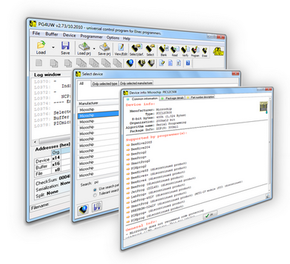
- Each programming module is driven by an easy-to-use control program with pull-down menu, hot keys and on-line help. Device selection is performed by its type, by manufacturer or simply by typing a fragment of the vendor name and/or part number. It is the same years-proven software, that is used for all other Elnec single-site programmers.
- Standard device-related commands (read, blank check, program, verify, erase) are enhanced by test functions (insertion test, connection check, signature-byte check), as well as some special functions (auto-increment, production mode - start immediately after insertion of chip into socket).
- All known data formats are supported. Automatic file format detection and conversion occurs during loading of the file. It is possible to use Jam files (JEDEC standard JESD-71) and VME files
- The rich-featured auto-increment function enables one to assign individual serial numbers to each programmed device - or simply increments a serial number. The function also enables one to read serial numbers or any programmed device identification signatures from a file.
- The software also provides considerable information about programmable devices. As a selection aide, drawings of all available packages are provided. The software provided also explains chip labelling (the meaning of prefixes and suffixes on the chips) for each supported IC.
Care for the customers
- New Device Request (AlgOR Service)
- It is important to remember, that a support of most of the new devices requires only a software update, because the BeeHive208S is based on the truly universal (BeeProg2) programmer. With our prompt service you often can have a new device added to the list of supported devices within hours! See AlgOR (Algorithm On Request) service and OnDemand software for details.
- This service is in almost all cases free. Please note, however, that we can ask the customer to share the costs, if development and manufacturing costs are too high.
- Free life-time software updates
- Most current version of Elnec programmers software, with support of newly added devices, is available for free here
- Free Technical support
- Elnec provide customers technical support (WebForm/e-mail based) available usually within a few hours, or at the latest, the next working day.
- Keep-Current service
- Keep-Current service means, that Elnec ships the latest version of programmer software and updated user documentation (Keep-Current package) to the customer . The Keep-Current service is your hassle-free guarantee that you are achieving the highest quality programming on Elnec programmers, at minimal cost.
- Prompt delivery
- Combination of extensive stock, flexible manufacturing and shipping of Elnec products by world class carriers (like DHL) warrants customers very fast and secure delivery of ordered Elnec products. Products ordered before 10 a.m. (CET) will be dispatched the same working day (if products are in stock and the payment is done by Online payment (CardPay, PayPal).
- Warranty

- Elnec provides free shipping of programmer repaired under warranty back to customers worldwide. The warranty is valid from the date of purchase.
- Preferential handling of repair requests ensures registration of the product that should be done within 60 days from the date of purchase Product registration.
Specifications (the BeeHive208S multiprogramming system)
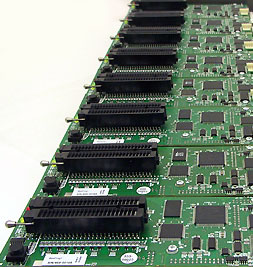
- 8x universal programming module (8x 48-pin DIL ZIF sockets and 8x ISP connectors)
- operation result LEDs, LED power indicator
- banana jack for ESD wrist strap connection
- banana jack for connection to ground
Specifications (PC system internal to the programmer)
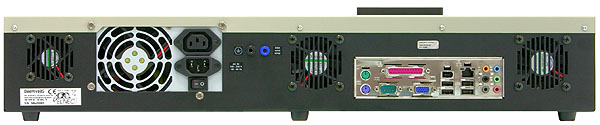
- Microsoft Windows 10 IoT Enterprise operating system
- CPU Intel Core i5 - 2.6GHz
- 8 GB RAM
- 1 TB HDD
Specifications (valid for each programming module)
HARDWARE
Base unit, DACs
- USB 2.0 high-speed compatible port, up to 480 Mbit/s transfer rate
- on-board intelligence: powerful microprocessor and FPGA based state machine
- three D/A converters for VCCP, VPP1, and VPP2, controllable rise and fall time
- VCCP range 0..8V/1A
- VPP1, VPP2 range 0..26V/1A
- selftest capability
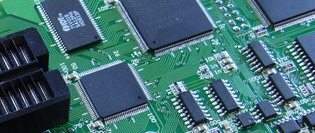
ZIF sockets, pin-driver
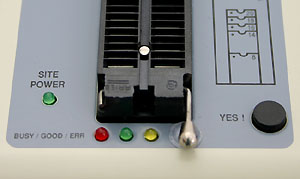
- 48-pin DIL ZIF (Zero Insertion Force) socket accepts both 300/600 mil devices up to 48-pin
- pindrivers: 48 universal
- VCCP/VPP1/VPP2 can be connected to each pin
- perfect ground for each pin
- FPGA based TTL driver provides H, L, CLK, pull-up, pull-down on all pin-driver pins
- analog pin-driver output level selectable from 1.8V up to 26V
- current limitation, over-current shutdown, power failure shutdown
- ESD protection on each pin of socket (IEC1000-4-2: 15kV air, 8kV contact)
- continuity test: each pin is tested before every programming operation
ISP connector
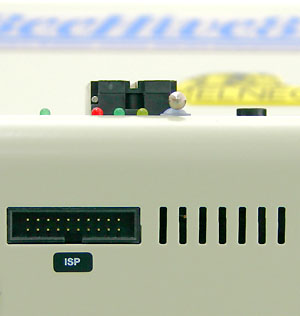
- 20-pin male type with miss-insertion prevention
- 6 TTL pin-drivers provide H, L, CLK, pull-up, pull-down; level H selectable from 1.8V up to 5V to handle all (low-voltage including) devices.
- 1x VCCP voltage (range 2V..7V/100mA), can be applied to two pins
- programmed chip voltage (VCCP) with both source/sink capability and voltage sense
- 1x VPP voltage (range 2V..25V/50mA), can be applied to six pin
- target system supply voltage (range 2V..6V/250mA), precision of settings +- 5%
- ESD protection on each pin of ISP connector (IEC1000-4-2: 15kV air, 8kV contact)
- two output signals, which indicate state of work result = LED OK and LED Error (active level: min 1.8V)
- input signal, switch YES! equivalent (active level: max 0.8V)
Software
- Algorithms: only manufacturer approved or certified algorithms are used.
- Algorithm updates: software updates are available regularly, approx. every 4 weeks, free of charge (Internet download). OnDemand version of software is available for highly needed chips support and/or bugs fixes. Available nearly daily.
- Main features: revision history, session logging, on-line help, device and algorithm information.
Device operations
- standard:
- intelligent device selection by device type, manufacturer or typed fragment of part name
- automatic ID-based selection of EPROM/Flash EPROM
- blank check, read, verify
- program
- erase
- configuration and security bit program
- illegal bit test
- checksum
- interprete the Jam Standard Test and Programming Language (STAPL), JEDEC standard JESD-71
- interprete the VME files compressed binary variation of SVF files
- security:
- insertion test
- contact check
- ID byte check
- special:
- production mode (automatic start immediately after device insertion)
- lot of serialization modes (more type of incremental modes, from-file mode, custom generator mode)
- statistic
- count-down mode
Buffer operations
- view/edit, find/replace
- fill/copy, move, byte swap, word/dword split
- checksum (byte, word)
File load/save
- there is no download time because the embedded PC controls the programmer
- automatic file type identification/recognition
Supported file formats- unformatted (raw) binary
- HEX: Intel, Intel EXT, Motorola S-record, MOS, Exormax, Tektronix, ASCII-SPACE-HEX, ASCII HEX, Renesas Consolidated HEX
- Altera POF, JEDEC (ver. 3.0.A), eg. from ABEL, CUPL, PALASM, TANGO PLD, OrCAD PLD, PLD Designer ISDATA, etc.
- JAM (JEDEC STAPL Format), JBC (Jam STAPL Byte Code), STAPL (STAPL File) JEDEC standard JESD-71
- VME (ispVME file VME2.0/VME3.0)
Device support
Programmer, in ZIF socket:
- Parallel NAND Flash: 3D Plus 3DFNxxx, All-Flash AFAxxx, Alliance Memory AS9Fxxx, AMD AM30LVxxx, ATO Solution AFNDxxx, MST5xxx, Axia Memory Tech. AX20xxx, Chipsip CT49xxx, Deutron Electr. ASUxxx, Dosilicon FMNxxx, DSNDxxx, Eon Silicon Sol. EN27xxx, ESIGMA ES27xxx, ES71xxx, ESMT F59xxx, FM6xxx, Flexxon FHNDxxx, Fidelix FMNxxx, FORESEE FS33xxx, FSNxxx, Fudan Microelect. FM29xxx, GigaDevice GD9xxx, MD5Nxxx, GSTO GSSxxx, Hana Micron HM34xxx, HeYangTek HYNxxx, ICMAX IMSxxx, ISSI IS34xxx, IS35xxx, Intel JS29Fxxx, Jeju Semicoductor JS27xxx, JSFxxx, Kingston Techn. KSLxxx, KIOXIA (ex Toshiba) TC58xxx, TH58xxx, TY8xxx, TY9xxx, Macronix MX30xxx, MX60xxx, MX63xxx, Micron MT29Axxx, MT29Cxxx, MT29Fxxx, MT29Gxxx, MT29Rxxx, Micron (ex Numonyx ex STMicroelectronics) NANDxxx, MIRA P1Uxxx, PSUxxx, NANYA NM1xxx, NeuMem NM9Fxxx, Paragon PN61xxx, PowerFlash A1Uxxx, ASUxxx, FSUxxx, Samsung K5xxx, K9xxx, KM29Nxxx, KFGxxx, KFMxxx, SK Hynix H27xxx, HY27xxx, H8xxx, H9xxx, HYCxxx, HYDxxx, HYGxxx, SkyHigh (ex Cypress ex Spansion) S34Mxxx, Spansion S19MNxxx, S30Mxxx, S76xxx, Spectek FxxL41Axx, FxxL41Bxx, FxxL51Axxx, FxxL52Axxx, FxxM29Bxxx, FxxM40Axxx, FxxM49Axxx, UnilC SCNxxx, VDATA VDxxx, WeForce CT49xxx, Winbond W29Nxxx, W71xxx, XTX PN61xxx, XT27xxx, XT61xxx, YuXin Semicond. YX21xxx, Zentel A5Uxxx, Zetta ZDNDxxx, LBA-NAND Toshiba THGVNxxx
- Serial NAND flash: All-Flash AFAxxx, Alliance Memory AS5Fxxx, ATO Solution ATOxxx, Auton Technology 830Axxx, BIWIN BWxxx, Dosilicon DS35xxx, Etron Technology EM73xxx, EM78xxx, ESMT F50xxx, Fidelix FM35xxx, FORESEE FS35xxx, Fudan Microelect. FM25xxx, GigaDevice GD5Fxxx, GSTO GSSxxx, GTSxxx, Fudan Microelect. FM25xxx, HeYangTek HY25xxx, HYFxxx, HYLxxx, HUYANG 5Fxxx, ISSI IS37xxx, Jeju Semicoductor JS28xxx, Macronix MX31xxx, MX35xxx, MEMORITEK MK60xxx, Micron MT29Fxxx, MK Founder MKSxxx, Paragon PN26xxx, SiliconGo SGMxxx, SkyHigh S35xxx, SS SS25xxx, UnilC SCNxxx, UNIM UM19xxx, TX25xxx, Winbond W25Nxxx, XINCUN XCSPxxx, XTX PN26xxx, XT26xxx, YuXin Semicond. YX25xxx, Zentel ANVxxx, Zetta ZD35xxx, ZTE ZX29xxx
- HyperFlash: Cypress/Spansion/ISSI S26KL, S26KS series, Cypress/Spansion S26HL, S26HS series
- eMMC: Flexxon FEMCxxxxxx, Greenliant GLS85VMxxxxx, ISSI IS22xxxx, Kingston EMMCxxx, KIOXIA (ex Toshiba) THGBMxxxxxxxxxx, Micron MTFCxxxxxx, Phison PTExxxxx, Samsung KLMxxxxxxx, SanDisk SDINxxxx, SK Hynix (ex Hynix) H26Mxxxxxxxx, Swissbit SFEMxxxxxxxxxxxxxxxxx series
- eMCP: Micron MT29xZZZxxxxxxxx
- eSD: XTX Technology XTSDxxGLGxxx, All-Flash SDVxxxMxxxxx series
- Memory Cards: MMC, SD, SDHC, SDXC series
- Multi-chip devices: NAND+RAM, NOR+RAM, NOR+NOR+RAM, NAND+NOR+RAM
- Serial NOR Flash: standard SPI, Multi I/O - Dual I/O, Quad I/O, Dual-Quad I/O, Octa I/O (25Bxxx, 25Dxxx, 25Exxx, 25Fxxx, 25Hxxx, 25Lxxx, 25Mxxx, 25Pxxx, 25Qxxx, 25Rxxx, 25Sxxx, 25Txxx, 25Uxxx, 25Vxxx, 25Wxxx, 25Xxxx, 25LW/UW/LM/UMxxx, XPxxx, 26Vxxx, 28HS/HLxxx, 35Xxxx, 45PExx, 55LX/Xxxx, 65U/Lxxx, 66L/LM/UM/UWxxx, 70FL/FSxxx, 74xxx, 77xxx, 78xxx, 79FLxxx, 98FLxxx series), DataFlash (AT45Dxxx, AT26Dxxx series)
- Parallel NOR Flash: 28Fxxx, 29Cxxx, 29Fxxx, 29BVxxx, 29LVxxx, 29ALxxx, 29GLxxx, 29JLxxx, 29PLxxx, 29Wxxx, 49Fxxx series, Samsung K8Fxxxx, K8Cxxxx, K8Sxxxx, K8Pxxxx series, ...
- EPROM: NMOS/CMOS, 27xxx and 27Cxxx series
- EEPROM: NMOS/CMOS, 28xxx, 28Cxxx, 27EExxx series, 3D Plus 3DEExxxxxxxx
- mDOC H3: SanDisk (ex M-Systems) SDED5xxx, SDED7xxx, MD2533xxx, MD2534xxx, Hynix HY23xxx
- FRAM: Ramtron
- MRAM: Everspin MRxxxxx8x, 3D Plus 3DMRxxxxxxxx
- NV RAM: Dallas DSxxx, SGS/Inmos MKxxx, SIMTEK STKxxx, XICOR 2xxx, ZMD U63x series
- Serial EEPROM: 11LCxxx, 24Cxxx, 24Fxxx, 25Cxxx, 30TSExxx, 34Cxxx, 34TSxx, 59Cxxx, 85xxx, 93Cxxx, NVM3060, MDAxxx series, SPD5118, full support for LV series, AT88SCxxx
- Serial FRAM: Infineon(Cypress, Ramtron): FM25xxxxxx, RAMXEED(Fujitsu): MB85RCxxxx, MB85RSxxxx, Lapis(OKI, Rohm): MR44xxxxx, MR45xxxxx, Smart Memories: SF24Cxxx, SF25Cxxx
- Serial MRAM: Everspin: MH20xxx, MH25xxx , Avalanche Tech.: AS100xxxxx, AS100xxxxx, Renesas(IDT): M30xx204xxxx
- Serial NV RAM: Infineon(Cypress): CY14Mxxxx, Anvo-Systems ANV32xxxx
- Serial ReRAM: RAMXEED(Fujitsu): MB85ASxxx
- Configuration (EE)PROM: XCFxxx, XC17xxxx, XC18Vxxx, EPCxxx, EPCSxxx, EPCQxxx, AT17xxx, AT18Fxxx, 37LVxx
- 1-Wire E(E)PROM: DS1xxx, DS2xxx
- Optical Transceivers: SFP, SFP+, QSFP+, XFP
- PLD Altera: MAX 3000A, MAX 7000A, MAX 7000B, MAX 7000S, MAX7000AE, MAX II/G/Z, MAX V, MAX 10
- PLD Intel: MAX II/G/Z, MAX V, MAX 10
- PLD Lattice: ispGAL22V10x, ispLSI1xxx, ispLSI1xxxEA, ispLSI2xxx, ispLSI2xxxA, ispLSI2xxxE, ispLSI2xxxV, ispLSI2xxxVE, ispLSI2xxxVL, LC4xxxB/C/V/ZC/ZE, M4-xx/xx, M4A3-xx/xx, M4A5-xx/xx, M4LV-xx/xx, ispCLOCK, Power Manager/II, ProcessorPM, iCE40 UltraPlus, iCE40 Ultra/UltraLite, iCE40 LP/HX, CrossLink, CrossLinkPlus, Platform Manager/2, L-ASC10
- PLD: Xilinx: XC9500, XC9500XL, XC9500XV, CoolRunner XPLA3, CoolRunner-II
- SPLD/CPLD series: AMD, AMI, Atmel, Cypress, Gould, ICT, Lattice, National Semicond., Philips, STMicroelectronics, TI (TMS), Vantis, VLSI
- FPGA: Anlogic SALELF2, SALELF3
- FPGA: Intel/Altera, non-volatile key: Cyclone V, Arria 10
- FPGA: Gowin LittleBee, Arora
- FPGA: JingZhong Wily
- FPGA: Lattice: MachXO, MachXO2, LatticeXP, LatticeXP2, ispXPGA, MachXO3, MachXO3D, MachXO5-NX
- FPGA: Lattice, non-volatile key: ECP2 S-Series
- FPGA: Microsemi(Actel): ProASIC3, IGLOO, Fusion, ProASICplus, SmartFusion
- FPGA: Pango Compa
- FPGA: Xilinx: Spartan-3AN
- Clocks: Cypress, Renesas (IDT), Silicon Laboratories, Skyworks Solutions, TI(TMS)
- Special chips:
- Tire Pressure Monitoring: Atmel: ATA6285N, ATA6286N, Infineon: SP3x
- Digital Multiphase/Power controllers/Power modules: Infineon(IR, CHiL Semiconductor): XDPE1xxxxx, TDA38xxx, IR3xxxx, CHL8xxxx, MPS: MP2xxxx, MPM54xxx, Analog Devices (Linear Technology, Maxim): ADM1xxx, ADP10xx, LTC2xxx, LTC3xxx, LTC7xxx, LTM4xxx, MAX20xxx, MAX34xxx, TI (TMS) TPS5xxxx, TPS6xxxx, UCD3xxxxx, UCD9xxxxx, Renesas(Intersil): RAA228xxx, RAA229xxx, ISL68xxx, ISL69xxx, Maxlinear(Exar): XR771xx, XRP77xx, PWM controllers: Zilker Labs ...
- Capacitive Sensors: Azoteq IQSxxxx
- Gama buffers: AUO, Maxim, TI, ...
- SoC and modules Espressif: ESP32, ESP32-C2, ESP32-C3, ESP32-C6, ESP32-S2, ESP32-S3, ESP32-H2 series
- Microcontrollers MCS51 series: 87Cxxx, 87LVxx, 89Cxxx, 89Sxxx, 89Fxxx, 89LVxxx, 89LSxxx, 89LPxxx, 89Exxx, 89Lxxx, all manufacturers, Philips LPC series
- Microcontrollers Intel 196 series: 87C196 KB/KC/KD/KT/KR/...
- Microcontrollers Artery: AT32F403xxx, AT32F421xxx
- Microcontrollers Atmel ARM. AT91SAM7Sxx, AT91SAM7Lxx, AT91SAM7Xxx, AT91SAM7XCxx, AT91SAM7SExx series;
- Microcontrollers Atmel ARM9: AT91SAM9xxx series;
- Microcontrollers Atmel ARM Cortex-M3: ATSAM3Axxx, ATSAM3Uxxx, ATSAM3Nxxx, ATSAM3Sxxx, ATSAMD20, ATSAM3Xxxx series
- Microcontrollers Atmel ARM Cortex-M4: ATSAM4Sxxx series
- Microcontrollers Atmel/Microchip AVR 8bit/16bit: AT90Sxxxx, AT90pwm, AT90can, AT90usb, ATtiny, ATmega, ATxmega series
- Microcontrollers Atmel/Microchip AVR32: AT32UC3xxxx, ATUCxxxD3/D4/L3U/L4U series
- Microcontrollers Atmel/Microchip ARM Cortex-M0+: ATSAMD2x, ATSAMDA1, ATSAMC2x, ATSAMD09x, ATSAMD10x, ALSAML2x, ATSAMHAx, ATSAMR2x, ATSAMR3x series
- Microcontrollers Atmel/Microchip ARM Cortex-M4: ATSAM4Sxxx, ATSAM4Ex, ATSAM4Cx, ATSAMG5x, ATSAM4LCx, ATSAM4LSx series
- Microcontrollers Coreriver (Gencore): Atom 1.0, MiDAS 1.0, 1.1, 2.0, 2.1, 2.2, 3.0 series
- Microcontrollers Cypress: CY7Cxxxxx, CY8Cxxxxx
- Microcontrollers ELAN: EM78Pxxx
- Microcontrollers EPSON: S1C17 series
- Microcontrollers Explore Microelectronic: EPF01x, EPF02x series
- Microcontrollers Geehy: APM32A0xx, APM32A1xx, APM32A4xx, APM32E0xx, APM32E1xx, APM32F00x, APM32F0xx, APM32F1xx, APM32F4xx
- Microcontrollers Generalplus: GPM8Fxxx series
- Microcontrollers GigaDevice: GD32A1xx, GD32A5xx, GD32C1xx, GD32E1xx, GD32E2xx, GD32E5xx, GD32F1xx, GD32F2xx, GD32F3xx, GD32F4xx
- Microcontrollers GreenPeak: GPxxx series
- Microcontrollers Infineon(Siemens): XC800, C500, XC166, C166, XC2000, XE164, TC2xx, TC3xx, TC17xx series
- Microcontrollers ITE Tech. Inc.: IT5xxx, IT6xxx, IT8xxxx
- Microcontrollers MDT 1xxx and 2xxx series
- Microcontrollers Megawin: MG87xxx, MPC82xxx series
- Microcontrollers Microchip PICmicro: PIC10xxx, PIC12xxx, PIC16xxx, PIC17Cxxx, PIC18xxx, PIC24xxx, dsPIC, PIC32xxx series
- Microcontrollers Microchip AVR 8bit: AVR DA, DB, DD, DU, EA, EB, SD series
- Microcontrollers Microchip ARM Cortex-M0: PIC32CM-MC, PIC32CM-JH, PIC32CM-GV series
- Microcontrollers Microchip ARM Cortex-M23: PIC32CM-LE series
- Microcontrollers Microchip ARM Cortex-M4: PIC32CX series
- Microcontrollers MindMotion MM32F0020xxx, MM32F031xxx
- Microcontrollers Motorola/Freescale/NXP: HC05, HC08, HC11, HC12, HCS08, RS08, S12, S12X, MC56F, MCF51, MCF52 series, Kinetis (K, KL, KE, KV, KM, KEA), Qorivva/Power Architecture xPC5xxx, S32K, MWCTxxxx
- Microcontrollers Myson Technology (Myson Century): MTV2xx, 3xx, 4xx, 5xx, CS89xx series
- Microcontrollers National: COP8xxx series
- Microcontrollers NEC: uPD70Fxxx, uPD78Fxxx series
- Microcontrollers Novatek: NT68xxx series
- Microcontrollers Nordic Semiconductor: nRF24LExxx, nRF24LUxxx, nRF315xx, nRF51xxx, nRF52xxx, nRF54xxx, nRF91xxx Flash and OTP series
- Microcontrollers Nuvoton ARM Cortex-Mx: NUC1xx, NUC2xx, M0A2xxx, M03x, M05x, M25x, M26x, M45x, M48x, Mini51, NM1xxx, NANO1xx, NUC029xxx, NDA1xx, N5xx, NPCXxxx series
- Microcontrollers Nuvoton (Winbond): MS51xxx, ML51xxx, N76xxx, N78xxx, N79xxx, W77xxx, W78xxx, W79xxx, W83xxx series
- Microcontrollers Nuvoton: KM101, KM103, MN1M7 series
- Microcontrollers NXP (Philips) ARM Cortex-Mx: LPC11xx, LPC11xxLV, LPC11Axx, LPC11Cxx, LPC11Dxx, LPC11Exx, LPC11Uxx, LPC12xx, LPC12Dxx, LPC13xx, LPC15xx, LPC17xx, LPC18xx, LPC40xx, LPC43xx, LPC8xx, EM7xx, LPC51xx, LPC54xxx, LPC55xx, MCXAxxx series
- Microcontrollers NXP (Philips) UOC series: UOCIII, UOC-TOP, UOC-Fighter (TDA1xxxx), PCF79xxx series
- Microcontrollers NXP (Philips) ARM7: LPC2xxx, MPT6xx, PCD807xx, SAF7780xxx series
- Microcontrollers NXP (Philips) ARM9: LPC31xx series
- Microcontrollers Panasonic: MN101, MN103, MN1M7 series
- Microcontrollers Pasat: TinyModule DIL40, DIL50 series
- Microcontrollers Puya PY32F0xx, PY32F4xx
- Microcontrollers Realtek: RTL875x, RTL876x, RTL872x, RTS54xx
- Microcontrollers Scenix (Ubicom): SXxxx series
- Microcontrollers Syntek: STK6xxx series
- Microcontrollers Renesas: Microcontrollers Renesas: R8C/Tiny series, RX series, uPD70Fxxx, uPD78Fxxx series, RL78 series, R32C series, H8 series, H8S series, H8 Tiny series, SH series, M16C series, Synergy series, RA series
- Microcontrollers SyncMOS: SM39xxx, SM59xxx, SM73xxx, SM79xxx, SM89xxx series
- Microcontrollers & Programmable System Memory STMicroelectronics: uPSD, PSD series
- Microcontrollers STM: STM32 SFI (secure firmware install): STM32L562RET [LQFP64](SFI), STM32U575OIYxQ [WLCSP90](SFI)
- Microcontrollers STM (ex SGS-Thomson): BlueNRG, ST6xx, ST7xx, ST10xx, STR7xx, STR9xx, STM32C/F/G/H/L/U/W, STM8A/S/L series, SPC5 (Power Architecture), STM32F0xx, STM32F1xx, STM32F2xx, STM32F3xx, STM32F4xx, STM32F7xx, STM32L0xx, STM32L1xx, STM32L4xx, STM32W108
- Microcontrollers Silicon Laboratories(Cygnal): C8051 series
- Microcontrollers Silicon Laboratories(Energy Micro): EFM32PGxx, EFM32ZGxx, EFR32BGxx, EFR32FGxx, EFR32MGxx, EFR32ZGxx, EFM8xx, EFM32Gxx, EFM32GGxx, EFM32LGxx, EFM32TGxx, EFM32WGxx series
- Microcontrollers Silicon Laboratories: SiM3Cxxx, SiM3Lxxx, SiM3Uxxx series
- Microcontrollers Telink Semicond.: TLSR82xxx, TLSR83xxx, TLSR92xxx
- Microcontrollers TI (Chipcon): CC11xx, CC13xx, CC24xx, CC25xx, CC26xx, CC85xx series
- Microcontrollers Texas Instruments: MSP430, MSC12xx, MSPM0Cxxxx, MSPM0Gxxxx, MSPM0Lxxxx, RM4xLxxx, TMS320F, TMS570LSxxxx, CC430 series.
- Microcontrollers Texas Instruments (ex Luminary Micro): LM3Sxxx, LM3Sxxxx series, LM4Fxxxx series, TM4C series
- Microcontrollers Toshiba: TX00, TX03, TX04, TXZ3, TXZ3+, TXZ4 series
- Microcontrollers ZILOG: Z86/Z89xxx and Z8Fxxxx, Z8FMCxxxxx, Z16Fxxxx, Z16FMCxx, ZGP323xxxxxx, ZLF645xxxxxxx, ZLP12840xxxxx, ZLP323xxxxxxx series
- Microcontrollers other: EM Microelectronic, Spansion(Fujitsu), Goal Semiconductor, Hitachi, Holtek, Novatek, Macronix, Princeton, Winbond, Samsung, Toshiba, Mitsubishi, Realtek, M-Square, ASP, Coreriver, Gencore, EXODUS Microelectronic, Topro, TinyARM, VersaChips, SunplusIT, M-Square, NSING (Nations Technologies), QIXIN, Signetic, Tekmos, Weltrend, Amic, Cyrod Technologies, Ember, Ramtron, Nordic Semiconductor, Samsung, ABOV Semiconductor, Iflytek, Telink Semiconductor, Lapis, Qorvo, Luminary Micro, Energic Technology, Trident Microsystem, Fresco Logic, Parade, Ene Technology Inc, HangZhou Nano IC, ETA CHIPS, Melexis, Yuntu ...
- EPROM: 2708 *1
- PLD: Bipolar PALxxx *2
Programmer, through ISP connector:
- Serial EEPROM: IIC series, MW series, SPI series, KEELOQ series, PLD configuration memories, UN I/O series
- 1-Wire EEPROM: DS1xxx, DS2xxx
- Serial NOR Flash: standard SPI (25xxx), DataFlash (AT45Dxxx, AT26Dxxx)
- Configuration (EE)PROM: AT17xxx, AT18Fxxx, EPCxxx, EPCSxxx, EPCQxxx, XCFxxx, XC18Vxxx
- Serial FRAM: Cypress(Ramtron): FM24xxxxxx, FM25xxxxxx, Fujitsu: MB85RCxxxx, MB85RSxxxx, Lapis(OKI, Rohm): MR44xxxxx, MR45xxxxx
- Microcontrollers Atmel/Microchip: AT89Cxxx, AT89Sxxx, AT89LSxxx, AT89LPxxx, AT90pwm, AT90can, AT90usb, AT90Sxxxx, ATtiny, ATmega, ATxmega series
- Microcontrollers Atmel/Microchip AVR32: AT32UC3xxxx, ATUCxxxD3/D4/L3U/L4U series
- Microcontrollers Atmel ARM7: AT91SAM7Sxx, AT91SAM7Xxx, AT91SAM7XCxx, AT91SAM7SExx series;
- Microcontrollers Cypress: CY8C2xxxx
- Microcontrollers Elan: EM78Pxxx, EM6xxx series
- Microcontrollers EM Microelectronic: 4 and 8 bit series
- Microcontrollers Microchip PICmicro: PIC10xxx, PIC12xxx, PIC16xxx, PIC17xxx, PIC18xxx, PIC24xxx, dsPIC, PIC32xxx series
- Microcontrollers Mitsubishi: M16C
- Microcontrollers Motorola/Freescale: HC08 (both 5-wire, All-wire), HC11, HC12, HCS08, S12, S12X, MC56F, MCF52, Kinetis K series
- Microcontrollers Nordic Semiconductor: nRF24LExxx, nRF24LUxxx, nRF315xx, nRF5xxxx Flash and OTP series
- Microcontrollers Nuvoton ARM Cortex-Mx: NUC1xx, NUC2xx, M0A2xxx, M03x, M05x, M25x, M26x, M45x, M48x, Mini51, NM1xxx, NANO1xx, NDA1xx series
- Microcontrollers Nuvoton (Winbond): MS51xxx, ML51xxx series
- Microcontrollers NXP (Philips) ARM7: LPC2xxx, MPT6xx series
- Microcontrollers NXP (Philips) ARM Cortex-Mx: LPC11xx, LPC11xxLV, LPC11Axx, LPC11Cxx, LPC11Dxx, LPC11Exx, LPC11xxLV, LPC11Uxx, LPC12xx, LPC12Dxx, LPC13xx, LPC17xx, LPC18xx, LPC40xx, LPC43xx, EM7xx, LPC8xx series
- Microcontrollers NEC: uPD7xxx series
- Microcontrollers Philips (NXP): LPCxx series, 89xxx series
- Microcontrollers Renesas: R8C/Tiny series, uPD7xxx series, RL78 series, RH850 series
- Microcontrollers Realtek, M-Square
- Microcontrollers Samsung: ICPZBSxxx series
- Microcontrollers Scenix (Ubicom): SXxxx series
- Microcontrollers Silicon Laboratories(Energy Micro): EFM32Gxx, EFM32GGxx, EFM32LGxx, EFM32TGxx, EFM32WGxx series
- Microcontrollers Silicon Laboratories: EFM32PGxx, EFM32ZGxx, EFR32BGxx, EFR32FGxx, EFR32MGxx, EFR32ZGxx, EFM8xx, SiM3Cxxx, SiM3Lxxx, SiM3Uxxx series
- Microcontrollers STM (ex SGS-Thomson): ST6xx, ST7xx, ST10xx, STR7xx, STR9xx, STM32F/L/W, STM8A/S/L series, SPC5 (Power Architecture)
- Microcontrollers Silicon Laboratories(Cygnal): C8051 series
- Microcontrollers & Programmable System Memory STMicroelectronics: uPSD, PSD series
- Microcontrollers TI (Chipcon): CC11xx, CC13xx, CC24xx, CC25xx, CC26xx, CC85xx series
- Microcontrollers TI: MSP430 series (both JTAG and BSL), MSC12xxx series, CC430 series, LM4F series, TM4C series, MSPM0Cxxxx, MSPM0Gxxxx, MSPM0Lxxxx series
- Microcontrollers ZILOG: Z8Fxxxx, Z8FMCxxxxx, Z16Fxxxx series, ZLF645x0xx
- Microcontrollers other: Realtek, M-Square, Luminary Micro, Qorvo
- Various PLD (also by Jam/VME/SVF/STAPL/... Player/JTAG support):
Altera: MAX 3000A, MAX 7000A, MAX 7000B, MAX 7000S, MAX 9000, MAX II/G/Z, MAX V
Xilinx: XC9500, XC9500XL, XC9500XV, CoolRunner XPLA3, CoolRunner-II - PLD Lattice: ispGAL22xV10x, ispLSI1xxxEA, ispLSI2xxxE, ispLSI2xxxV, ispLSI2xxxVE, ispLSI2xxxVL, M4-xx/xx, M4LV-xx/xx, M4A3-xx/xx, M4A5-xx/xx, LC4xxxB/C/V/ZC/ZE, ispCLOCK, Power Manager/II, ProcessorPM
- FPGA: Microsemi(Actel): ProASIC3, IGLOO, Fusion, ProASICplus, SmartFusion
- FPGA: Lattice: MachXO, MachXO2, LatticeXP, LatticeXP2, ispXPGA
Notes:
- devices marked * are obsolete, can be programmed with PLD-1 additional module or 2708 additional module
- the complicated devices with laborious implementation might belongs to the "Paid ISP support" category
- for all supported devices see DEVICE LIST.
Package support
- support devices in DIP into socket of the programmer
- package support includes DIP, SDIP, PLCC, JLCC, SOIC, SOP, PSOP, SSOP, TSOP, TSOPII, TSSOP, QFP, PQFP, TQFP, VQFP, QFN (MLF), SON, BGA, EBGA, FBGA, VFBGA, UBGA, FTBGA, LAP, CSP, SCSP etc. devices in non-DIP packages up to 48 pins are supported by universal programming adapters - if it is technically possible on the BeeHive208S programmer. That means if reliability of operations when used universal programming adapter is below industrial standard, the specialized programming adapters are necessary to use.
- programmer is compatible with many third-party adapters for non-DIP support
Programming speed

Notes:
- It is important to know that at Elnec we always use random number data patterns for programming speed testing. Some our competitors use a "sparse" data pattern, where only a few non-blank data addresses are programmed or they used data with only a few 0 bits (FE, EF, etc.). This deceptive approach can "decrease" programming time considerably. If you plan to compare, always ask what type of pattern they use for their advertised programming speed.
- The programming speed depends on PC speed only slightly, of course at condition the CPU usage is below 100%.
- If the programmer attached to PC through LPT port, the programming of high-capacity memories will take considerable longer time.
| Device | Size [bits] | Operation | Time | |
|---|---|---|---|---|
| K8P6415UQB (parallel NOR Flash) | 400100hx16 bit (64 Mega) | programming and verify | 13 sec. | |
| MT29F1G08ABAEAWP (parallel NAND Flash) *2 | 8400000Hx8 (1 Giga) | programming and verify | 51 sec. | |
| THGBM3G4D1FBAIG (eMMC NAND Flash) *2 | 2048 MB x8 (16 Giga) | programming *1 | 363 sec. | |
| QB25F640S33 (serial Flash) | 800200hx8 (64 Mega) | programming and verify | 30.7 sec. | |
| AT89C51RD2 (microcontroller) | 10000hx8 | programming and verify | 14.4 sec. | |
| PIC32MX360F512L (microcontroller) | 80000hx8 | programming and verify | 8.9 sec. | |
| Conditions: CPU Intel Core i5 -2.9GHz, 4 GB RAM, 500 GB HDD, Microsoft Windows Embedded 8.1 Industry Pro operating system | ||||
Notes:
- *1 - implementation is the same as in card readers. Verification of programming is performed by internal controller, where internal controller confirm the proper programming using status register.
- *2 - the programming time is for TurboMode active.
General
Documentation
- User manual for BeeHive208S (Microsoft Windows 10 IoT Enterprise) (PDF)
- User manual for BeeHive208S (Windows Embedded 8.1 Industry Pro) (PDF)
- User manual for BeeHive208S (Windows XP Embedded) (PDF)
Operation
- operating voltage 100-240V AC rated, 90-264V AC max., 47-63Hz
- power consumption max. 300W active
- maximal outside dimensions 625x465x115mm ( 24.6 x 18.3 x 4.5inch)
- weight (programmer) 14.9kg (32.85lb)
- operating temperature: 5°C ÷ 35°C (41°F ÷ 95°F)
- operating humidity: 20%..80%, non condensing
Package includes
Standard accessories:
- BeeHive208S programmer
- power cord (Europe)
- USB connection cable PC-programmer (1x)
- diagnostic pod for ZIF socket selftest of the programmer (1x)
- diagnostic pod for ISP connector selftest of the programmer (1x)
- 48 Pins Calibration test pod, Type I (1x)
- ISP cable (8x)
- anti-dust cover for ZIF socket (8x)
- USB flash drive
- CD with software and user's manual
- calibration test report
- transport case
Bonus pack:
- ESD wrist strap with cord and banana plug
- Vacuum pen
- Gift (surprise)
Additional services
- Keep Current - Elnec sends to user the latest version of programmer software and updated user documentation (Keep-Current package)
- AlgOR (Algorithms On Request) - add new supported devices at the customer's request
Programmer price also includes
- free technical support (WebForm/e-mail based)
- free life-time software update via Internet
History
- Operating system Microsoft Windows XP Embedded was used for BeeHive208S programmers manufactured till January 2015, programmers s/n range 1178-00001 - 1178-00170
- Operating system Microsoft Windows Embedded 8.1 Industry Pro was used for BeeHive208S programmers manufactured till January 2022, programmers s/n range 1178-00171 - 1178-00231
- Operating system Microsoft Windows 10 IoT Enterprise is currently used for BeeHive208S programmers, programmers s/n 1178-00232 and above
The information in this document is subject to change without notice.

